Posts

High Holy Day Sermon, Yom Kippur 2011/5772

I would like to offer two stories today – one true and one that is merely filled with truth. The first comes from one of my favorite chassidic tales and relates the story of a father with a rather simple son. During the High Holy Days, he would pray in the synagogue of the Baal Shem Tov, but never would bring his boy with him to pray. Finally when the boy reached the age of Bar Mitzvah, his father took him to the synagogue for the first time, but only out of fear that the boy would out of sheer ignorance eat on the holy fast day. The boy had a flute that he would play while tending the flock. Without his father knowing, he took the flute to shul . All day long the boy sat in silence in the synagogue. During the musaf prayer, the boy whispered to his father, “Father, I want to play my flute.” Terrified, the father spoke sharply and quite harshly to his son and the boy relented. This happened again and again during the minchah service, and each time the f...

Parashat Masei - 5771

I have spent a lot of time this week thinking about the tools of the streams of progressive Judaism—the tools of Wissenschaft des Judentums that have been passed down by our recent sages and handed to us to help redefine how we view our texts and our religious practice. The question I have is if the scientific tools that we have been given – textual and narrative criticism, scientific study of history, archeology, etc. are appropriate parts of the rabbinical tool chest to help elucidate our weekly readings and teachings. Do they have any place in the attempt to address the spiritual and existential needs of a congregation? Can they help at all in the process of tikkun olam – repairing the world? And then I came to this passage in the current weekly reading from Bamidbar, Parashat Masei: 33:50 The Eternal spoke to Moses in the plains of Moab by the Jordan, across from Jericho. He said: 33:51 “Speak to the Israelites and tell them, ‘When you have crossed t...

Parashat Terumah 5771 - English Version

(Translated from the German -- original version here .) It was our great teacher, Rav Indiana Jones, that first taught me and many other members of Beis Hollywood about the Ark of the Covenant. As a matter of fact, the film “Raiders of the Lost Ark” seems to offer a variety of insights into the nature of the Holy Ark. For example—we are taught that it is powerful, that it can destroy entire armies, that it is so mysterious and awesome that it gets a special moment of John Williams soundtrack when the Ark is discussed – and – that the Ark is today hidden away in some secret CIA warehouse. OK – perhaps all of these points aren’t really to be found in Torah. But there nonetheless seems to be a spark of truth behind the Beis Hollywood drama. We read in Parashat Terumah about the construction of the Ark of the Covenant—its material, its size and so forth, and then we come upon: (Exodus) 25:18 You are to make two cherubim of gold; you are to make them of hammered metal on the two ends o...

Why no Posting? (or . . . bad BAD Paul)

So -- I finally posted something, just not here. For my German speaking friends, family and colleagues I have set up a sister-blog to post the Drashot that I actually write down. (Oy -- I know -- once again bad BAD Paul.) The fact is, Geiger has a policy that all Drashot are written minimum 8 - days before a pulpit visit, that our Director of Student Placement can review and make suggestions/changes to a sermon. I actually believe this to be a positive idea, I am just not always successful in complying as it takes me ten times as long to formulate my thoughts in written German and I am still much more comfortable with five bullet points and free speaking. That being said, complying with my school's wishes is important, and in an effort to push myself, I will publish any Drashot that I successfully get on paper before a deadline. I have to give here also a huge shout-out to my German coach that has been helping me more than I can say getting this stuff done, and that made the ...

What I Did (am doing?!) On My Summer "Vacation"

Image
In the course of my rabbinical studies I have already been gifted with amazing opportunities and experiences. This summer as I study in Jerusalem at the Steinsaltz Yeshiva , however, one of the most intense of these experiences has arisen -- I was invited to sing with the choir at the Great Synagogue of Jerusalem for Selichot and the High Holy Days. Well, streaming vids are worth several terabytes worth of words, so I am posting a link to a video here -- sorry, I cannot imbed it and the site is all Hebrew -- that might help shed a little light on the nature of the experience. Several groups filmed Selichot this year at the Great Synagogue -- the sound is not great but certainly gives a little idea as to the nature of the music. For those of you that are not Jewish, and maybe even for some that are, this might be a bit of an alien experience. This video is 25 edited minutes from a 3 hour service that lasted until 1 in the morning (and unfortunately does not contain the early part...

Musings from the Yeshiva

I have been thinking a lot recently about the old New Age maxim that we create our own reality. This is a thought form that has existed in many guises throughout history, but hit the global collective conscious in the 60s. The only problem is that we didn’t really create are own reality – all the wonderful energy that went into this seems to have been somehow either misplaced or re-directed into the desire to create the reality of acquisition. Either way, the concept has been nagging at me recently and demanded my consideration. As one who has struggled my entire life with at times paralyzing amounts of self criticism, I have to lay my own challenge to the maxim. On the one hand, the idea of creating one’s own reality is freeing. It means that once we begin the process of challenging and questioning with the hope of living a conscious life-- as opposed to the birth-default mode of living life purely through the will and pattern of tribe/family/faith into which “chance” brought us—...

Backyard Terror

Image
I haven't known what to write about the latest incident of "tractor terror" in Jerusalem this past week. The first one took place near the open-air market that both Sandra and I frequented, and the violation of one of my "homes" affected me. But the latest one took place one block from HUC in one direction and ended one block from where Sandra and I lived in the other direction. So rather than try to address it, I want to share the words of the Dean of the HUC Jerusalem campus (and one of the finest gentlemen I have ever had the pleasure of learning from) that were posted in the Jerusalem post. Reform Reflections: Life and death on King David street Posted by Rabbi Michael Marmur For much of my adult life I have studied, taught and worked on King David Street in Jerusalem. It is certainly no ordinary work address. World leaders stay there - in recent months we have played host to Bush, Blair, then Bush again, Blair, Rice...

A Neat Piece of News

Image
(Picture note: One of my favorite of the Chagall Windows at Hadassah Medical Center in Jerusalem. The inspiration for the windows, other than Chagall's purely amazing creativity, was the section of Torah dealing with Israel/Jacob's blessings to his sons. The blessing that inspires this window starts, "Joseph is a fruitful bough, a fruitful bough by a spring; his branches run over the wall." Why is בן פרת, literally "descendant that bears fruit" repeated? I think because Torah, above else, has power by forcing us to ask questions and always examine and move forward in our lives, rather than leaving status quo alone. There is always work to do. As descendants of Israel we continue to ask the questions prompted by a repeated word here, and extra pronoun there. And in those Kleinigkeiten we find G-d because G-d is in the process of making connections much more than any temporary answer that we would wish to stand on and claim to be the only truth. At le...

It's Complicated

Image
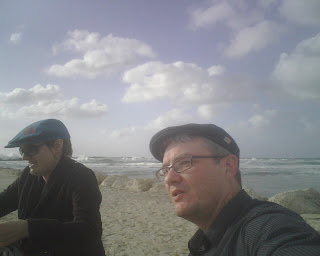
(Picture Note -- Sandra and I at the beach in Tel Aviv -- I am really going to miss this place.) During our first weeks in rabbinical school, we were told that our program was a combination professional school, graduate school, and seminary. Although I believe that there is truth in this analysis (after all, our hours spent in class seem to reflect three programs rather than one) I think that there is also an indefinable fourth school at play—let’s call it the discard-all-preconceived-notions-school— perhaps we might even call it the “pay close attention and you might learn something really valuable” school. HUC chooses to call it the “Israel Seminar,” and for anyone who decided this year to allow for the possibility that someone in Israel might know something more than they about this region, the Israel Seminar provided an education that money simply cannot buy. I had my own share of preconceptions about Israel . As a self-proclaimed moderate I believed that I possessed ...